

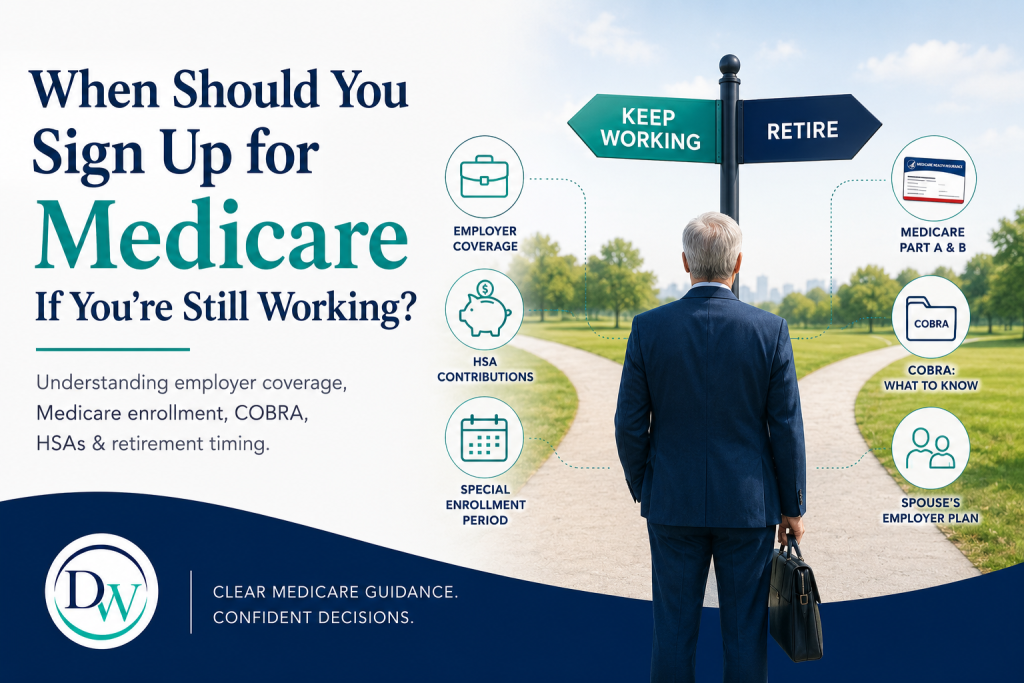
Still Working at 65? When Should You Enroll in Medicare?
If you're still working at 65, one of the biggest Medicare questions is whether you need to enroll right away or wait until you retire.
The answer is:
It depends.
Many people assume everyone must enroll in Medicare as soon as they turn 65. Others assume they can simply wait until they retire.
Neither assumption is always correct.
Whether you should enroll at age 65 depends on several factors, including:
- the size of your employer
- whether you have employer-sponsored health insurance
- whether you're covered under your own employer's group health plan or your spouse's group health plan
- whether that coverage is considered creditable under Medicare's rules
Because making the wrong decision can lead to gaps in coverage or lifetime late enrollment penalties, it's important to understand how the rules work before your 65th birthday.
The First Thing to Know: Turning 65 Doesn't Always Mean You Must Enroll
If you're already receiving Social Security benefits when you turn 65, you'll generally be enrolled automatically in Medicare Part A and Part B.
However, many people today continue working beyond age 65 and delay claiming Social Security. In that case, Medicare enrollment is usually not automatic, and you'll need to decide whether to enroll.
The right decision depends largely on your current health insurance.
If You Work for a Large Employer (20 or More Employees)
If you are actively employed and covered under a group health plan from an employer with 20 or more employees, you can usually delay enrolling in Medicare Part B without penalty.
In this situation, your employer's group health plan generally remains your primary insurance, which means the group health plan pays claims first, and Medicare would be secondary if you choose to enroll.
Many people in this situation:
- Enroll in premium-free Medicare Part A at age 65 (if eligible), and
- Delay Medicare Part B until they retire or lose their employer coverage.
However, enrolling in Part A isn't always the best decision, particularly if you're contributing to a Health Savings Account (HSA).
A Word About Health Savings Accounts (HSAs)
This is an area that catches many people by surprise.
Once you're enrolled in any part of Medicare, including premium-free Part A, you generally can no longer make new contributions to an HSA.
If you're still working and want to continue contributing to your HSA, you may choose to delay Medicare enrollment altogether.
Because Medicare Part A can be retroactive for up to six months when you eventually enroll (if you're eligible), many people stop HSA contributions several months before applying for Medicare to avoid tax issues.
If you have an HSA, it's worth planning your Medicare enrollment carefully.
If You Work for a Small Employer (Fewer Than 20 Employees)
Different rules generally apply if your employer has fewer than 20 employees.
In many cases, Medicare becomes your primary insurance once you're eligible.
That means if you delay enrolling in Medicare when you first become eligible, your employer health plan may not pay claims, and this can leave you on the hook for medical claims.
If you work for a smaller employer, it's especially important to understand how your employer's health plan coordinates with Medicare before deciding to delay enrollment. Group-sponsored plans can have different rules, so check with your employer whether your plan requires you to sign up for Medicare when eligible.
What If You're Covered Under Your Spouse's Employer Plan?
Many people continue working past 65, or retire before their spouse, and remain covered under their spouse's employer-sponsored health insurance.
The same general rules usually apply.
If your spouse's employer has 20 or more employees and you're covered under an active employee health plan, you can often delay Medicare Part B without penalty.
If the employer has fewer than 20 employees, different coordination rules may apply. Check with your employer whether your plan requires you to sign up for Medicare when eligible.
Should You Keep Your Employer Coverage or Enroll in Medicare?
Just because you're allowed to delay your Medicare enrollment doesn't necessarily mean it's the best financial or healthcare decision.
In some situations, Medicare may provide broader coverage or lower overall healthcare costs than your employer-sponsored health plan. In others, keeping your employer coverage may continue to make the most sense until you retire.
When comparing your options, consider factors such as:
- Your monthly premiums – Compare what you're actually paying out of pocket for your employer-sponsored health plan after your employer's contribution. Then compare those costs to Medicare, including the Part B monthly premium and, if applicable, any Income-Related Monthly Adjustment Amount (IRMAA) surcharges. Check out our article, What Will Medicare Cost Me
- Deductibles, copays, and coinsurance – Monthly premiums are only part of the picture. Compare what you'll pay when you actually use healthcare services. A plan with higher monthly premiums may have lower out-of-pocket costs, while a lower-premium plan may result in higher costs when you receive care.
- Prescription drug coverage – Review how each option covers your medications. If you're considering delaying Medicare Part D, confirm that your employer's prescription drug coverage is considered creditable to avoid future late enrollment penalties.
- Provider and hospital access - Make sure your preferred doctors, specialists, hospitals, and healthcare systems participate in the coverage you're considering. Some plans offer broader provider access than others.
- Out-of-pocket maximums - Understand the most you could be responsible for during the year if you experience a serious illness or unexpected medical event.
- Coverage for your spouse or dependents, if applicable - If family members are covered under your employer's health plan, enrolling in Medicare could affect their coverage or increase their premiums. The "best" choice isn't simply the one with the lowest monthly premium. It's the one that provides the right balance of cost, coverage, and flexibility for your individual situation.
If you're unsure how Medicare compares with your employer plan, you may find our article, "What Will Medicare Cost Me?" helpful, as it explains many of the costs and coverage considerations that should be part of the decision.
What Happens When You Retire?
When your employer coverage ends, you'll generally qualify for a Special Enrollment Period (SEP) that allows you to enroll in Medicare without incurring a late enrollment penalty.
In most cases, you have:
- Eight months to enroll in Medicare Part B after your employment or employer coverage ends (whichever occurs first), and
- A separate period to enroll in Medicare Part D or other creditable prescription drug coverage.
It's generally best not to wait until the end of your Special Enrollment Period since that could leave you with a gap in coverage. Planning ahead can help ensure your Medicare coverage begins when your employer coverage ends and avoid unnecessary gaps in coverage.
Watch Out: COBRA Is Not the Same as Active Employer Coverage!
Many people assume that because COBRA allows them to continue their employer health insurance after leaving their job, they can also delay enrolling in Medicare. In most cases, that's not true.
COBRA is not considered active employer group health coverage for purposes of delaying Medicare enrollment.
If you're eligible for Medicare and leave your employer, electing COBRA instead of enrolling in Medicare Part B can have serious consequences. You could:
- Face a late enrollment penalty for Medicare Part B.
- Experience a gap in coverage when your COBRA coverage ends.
- Find that COBRA pays secondary, or may even deny certain claims, once you're eligible for Medicare - even if you aren’t enrolled!
If you're approaching age 65 or retiring after age 65, don't assume that enrolling in COBRA means you can postpone Medicare. Before making that decision, understand how Medicare and your specific COBRA plan work together and make sure you're enrolling in Medicare during your Special Enrollment Period if required.
Don't Forget About Prescription Drug Coverage
Many people focus on Medicare Part B but overlook prescription drug coverage.
If your employer's prescription drug coverage is considered creditable coverage, you can generally delay enrolling in Medicare Part D without penalty.
Before leaving your employer plan, ask for a written notice confirming whether your prescription drug coverage is creditable. Keeping this documentation can be helpful if Medicare ever asks you to prove that you maintained qualifying coverage.
Every Situation Is a Little Different
One of the biggest mistakes I see is people assuming the rules are the same for everyone. What works for your neighbor or family member may not be what works for you. The facts and circumstances can be nuanced.
The right enrollment strategy can vary depending on:
- The size of your employer
- Whether you're still actively working
- Whether you're covered under your own employer or your spouse's
- Whether you contribute to a Health Savings Account
- Whether you plan to retire soon
- The type and costs of employer health coverage you have
These details matter, and small differences can significantly affect when you should enroll.
Putting It All Together
If you're working past age 65, don't assume you should automatically enroll in Medicare—or automatically delay it.
For many people, delaying Part B makes perfect sense. For others, delaying enrollment can result in gaps in coverage or permanent late enrollment penalties.
Understanding how Medicare coordinates with your employer coverage before making a decision can help you avoid costly mistakes and make the transition to Medicare much smoother.
Questions About Your Medicare Timing?
If you're approaching age 65 and aren't sure whether you should enroll in Medicare or continue with your employer coverage, it's worth reviewing your situation before making a decision.
A short conversation now can help prevent expensive mistakes later.
If you'd like personalized guidance evaluating your Medicare options, DiscoverWell Medicare is happy to help.